ACHMAD SUFAN WICAKSONO
04:45

RAM in Los Angeles

District Court in LA Decides Computer RAM Memory Must Be Preserved and Produced

RAM Computer Memory ChipsA Los Angeles District Court rocked the e-discovery world last month by holding, for the first time, that the contents of a computer’s Random Access Memory (”RAM”) memory are discoverable. Columbia Pictures Industries v. Bunnell. The Order dated May 29, 2007, by Magistrate Judge Jacqueline Chooljian was entered in a copyright infringement case against the owners of the popular media search-engine web, TorrentSpy. The order has been highly criticized by computer experts and e-discovery lawyers alike for greatly expanding the legal duty to preserve and produce electronic data to the most elusive and transitory of information, that held only in a computer’s RAM chips.

Many contend that this a rogue decision, and if not reversed on appeal could force companies and individuals to store and produce vast amounts of data that would otherwise exist only temporarily on their computer’s RAM hardware. Ken Withers, director of The Sedona Conference, was quoted by CNET News as stating that he feared the judge’s decision may mean a “tremendous expansion” of the scope of discovery in civil litigation, creating yet another what he calls “weapon of mass discovery.” By this,he means a discovery burden that could be tremendously expensive to meet, and thus could be exploited by plaintiffs and defendants alike to force the settlement of a dispute to avoid that expense.

Commentators all seem to agree that in most circumstances, if not all, it would be prohibitively burdensome for a person or company to try to preserve and produce the transitory contents of computer memory. The burdensomeness would derive not only from the expense, but also from the disruptive actions required to comply.

Moreover, many contend that an order requiring the production of RAM data necessarily requires a party to create computer records where none before existed. This goes against a fundamental legal precept that a party is only required to produce documents and electronically stored information that have already been created and stored. A party to litigation is never required to generate and create new documents and information so as to satisfy the curiosity of the opposing party. As Ken Withers stated in the CNET article:

There’s never been a requirement that (defendants) must create documents that they wouldn’t ordinarily maintain for the purpose of satisfying some (plaintiff’s) discovery requests.

Judge Chooljian considered this argument, but rejected it, because in her view, the information already existed in RAM. She concluded that the defendants were not required to create new data, they were just required to transfer it to permanent form and preserve it.

Withers and others think the order is ill conceived in part because it is based on a misunderstanding of technology and computer memory. Computer memory RAM files are temporary files that are created by the computer for operational efficiency. Computer memory like this is by nature information designed only for very temporary storage in the memory chips of a computer. It is quickly overwritten and is always purged - literally disappears - when a computer is turned off. (Unpowered RAM memory chips contain no information of any kind.) The same CNET News article also quotes Dean McCarron, principle analyst at Mercury Research, as saying:

RAM is the working storage of a computer and designed to be impermanent. Potentially your RAM is being modified up to several billions of times a second. The judge’s order simply reveals to me a lack of technical understanding.

In short, RAM memory is temporary and transitory, and leaves no trace or record. Still, a computer system can be designed so that information temporarily stored in RAM is copied onto a hard drive or flash memory storage where it then becomes fixed.

Before this decision, most e-discovery attorneys I know thought that only information fixed on a storage device, such as a hard drive, flash memory or Read Only Memory (ROM) (which are permanent), CD, DVD, etc., would be considered “stored” and thus discoverable under the new Rules as “Electronically Stored Information”. See, e.g., Rule 34 and commentary in the Page 34 at the top of the Blog. This decision broadens the meaning of “stored” to include the temporary holding of information in a volatile memory chip.

The opinion concedes that computer RAM memory has never previously been adjudicated to be Electronically Stored Information (”ESI”) under new Rule 34. For that reason, Judge Chooljian declined to impose sanctions on defendants for failing to preserve and produce the RAM ESI in the past, but she did order its preservation and production going forward. Although the opinion concedes it is a case of first impression for construction of Rule 34, Judge Chooljian argues that her conclusion is compelled by the unique circumstances of this case and prior Ninth Circuit law, primarily MAI Systems Corp. v. Peak Computer, Inc., 991 F.2d 511, 518-519 (9th Cir. 1993). The MAI Systems case is well known for its holding that the copying of software into RAM memory is equivalent to “affixing” it in a tangible medium for purposes of copyright law, where ”fixed” is a term of art. Judge Chooljian reasoned that if information in RAM was sufficiently fixed to constitute a copyright infringement, then it was sufficiently fixed for purposes of discoverability as electronically stored information.

In this case, the RAM memory at issue was the information stored for up to six hours, but no longer, on the webserver for the TorrentSpy web, as to what web-pages were downloaded, when, by whom, and other similar information. That is called a webserver log. For this particular kind of RAM data, it is not technically difficult to set up a webserver so that the log is transferred from RAM to a permanently stored file on the hard drive. Many webs are set up to do this. These website owners want to keep track of who visits their site, which pages are the most popular, etc.

But TorrentSpy did not set up their system that way. They did not want to have any tracking information on their users, and in fact they put this privacy guaranty in their user agreement. The Plaintiffs in this case, Columbia Pictures Industries, et al., were frustrated by the fact that the defendants did not know who its users were, and in fact did not want to know. Plaintiffs claimed that TorrentSpy’s users were illegally downloading their copyrighted materials - their movies, music and television shows - based on information they obtained from TorrentSpy’s web. Plaintiffs claimed that TorrentSpy set up their computer systems with RAM anonymity on purpose in order to encourage their users to steal plaintiffs’ copyrighted materials without fear of being caught.

Note that the plaintiffs do not claim that their copyrighted materials are stored on TorrentSpy’s web, and do not claim that TorrentSpy’s users downloaded the files from TorrentSpy. It appears to be undisputed that TorrentSpy “only” provides information as to where these materials are located, usually on the computers of individuals located around the world. Plaintiffs sued the TorrentSpy web owners, and not the individuals who illegally downloaded the files or the individuals who supplied the files (for free), based on theories of vicarious copyright infringement, contributory infringement, and inducement.

Here, in my view, is where an old legal axiom comes in: “bad facts make bad law.” The facts in this case are unusual. The judge was convinced that the webserver logs were essential to the plaintiffs’ case. This much is certain, and this is a highly unusual situation. Moreover, the tone of the opinion suggests that the judge thinks the plaintiffs are likely to prevail if they obtain these logs, that it will enable them to prove their infringement conspiracy theories. The plaintiffs have successfully argued that defendants were hiding this crucial evidence in their RAM, and that this was an essential part of their conspiracy to steal their intellectual property.

Further, the defendants were, according to Judge Chooljian, unable to demonstrate that it would be “unduly burdensome” for them to transfer all of the webserver logs on an ongoing basis from RAM to hard drive, and thereafter to preserve and produce this evidence. The court was referring to the burden of proof placed on a party opposing discovery under new Rule 26(b)(2)(B). Under this rule, ESI is not discoverable if the party opposing discovery can show that it is “not reasonably accessible because of undue burden or cost.” Personally, I am surprised defendants could not prove undue burden or costs. If they had, then under Rule 26(b)(2)(B) the burden of proof would have shifted to the plaintiffs to provide good cause that the “not reasonably accessible” information be produced anyway. Apparently defendants failed because the court went entirely with the plaintiffs’ expert, and rejected defendants’ contrary testimony. This certainly shows the importance of credible experts, especially in a case like this.

Judge Chooljian appears to recognize that her decision would be controversial, and took some pains to note that it was not intended to serve as precedent for the routine discovery of computer memory in other cases. Her position is explained in footnote 31, at page 31 of the 35-page opinion:

The court emphasizes that its ruling should not be read to require litigants in all cases to preserve and produce electronically stored information that is temporarily stored only in RAM. The court’s decision in this case to require the rentention and production of data which otherwise would be temporarily stored only in RAM, is based in significant part on the nature of this case, the key and potentially dispositive nature of the Server Log Data which would otherwise be unavailable, and defendants’ failure to provide what this court views as credible evidence of undue burden and cost.

I do appreciate this footnote.

POSTSCRIPT: The Magistrate’s discovery ruling was appealed and later approved by the district court judge. See: Order Denying Defendants’ Motion For Review dated Aug. 24, 2007, Columbia Pictures Industries v. Bunnell, 245 F.R.D. 443 (C.D. Cal. 2007).




04:36

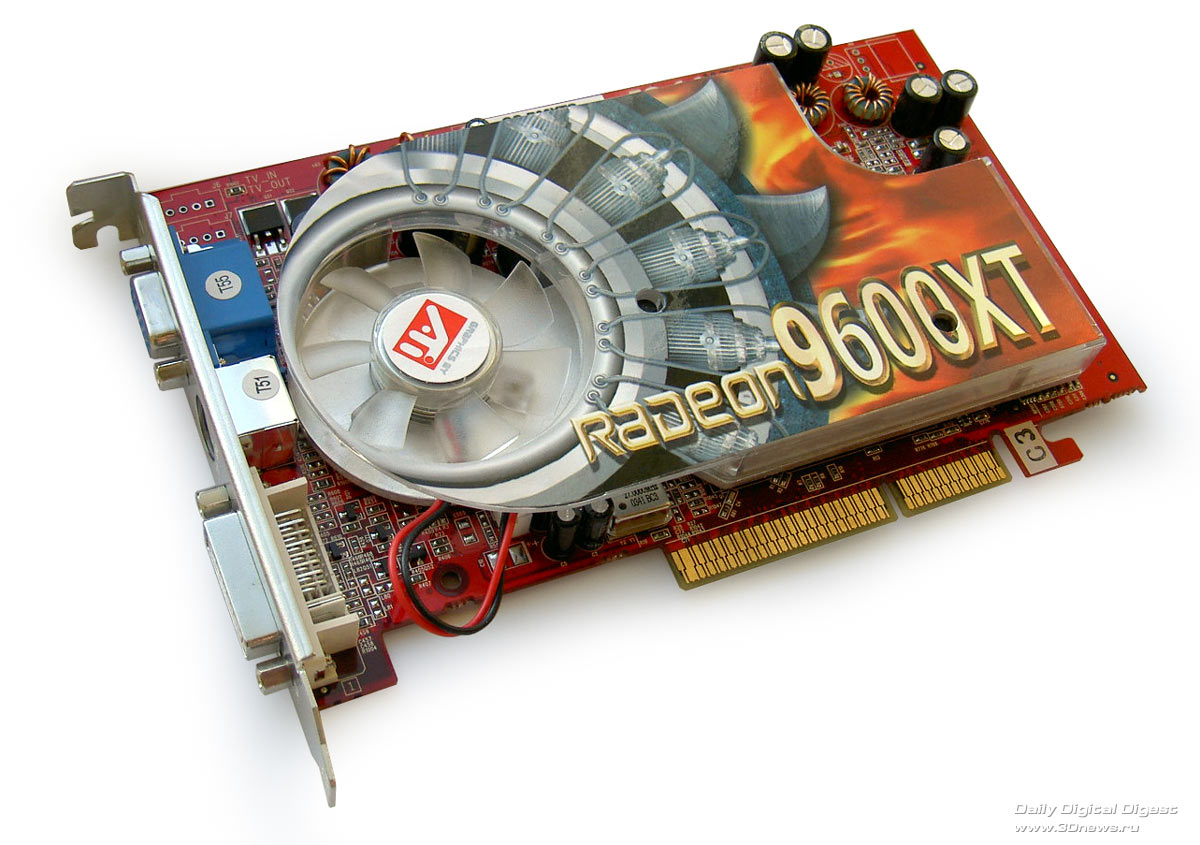
GeXcube Radeon 9600XT Extreme

Info-Tek Corp. Taiwan, and its GeXcube brand of graphic products are still little known in Russia, and it makes sense telling a bit more about them. The company was established in 1990 as a developer and supplier of solely video cards. To date, these are only cards built on ATI chips, and the company is not going to change such strategy.

22% of the company property is owned by IT specialists of GIGABYTE, with the major package of shares owned by a Taiwanese millionaire investor. The management, marketing, engineering and quality assurance services are based in a united building within the numerous techno-parks of Taipei, by the way, in the same building where AOpen are based. The manufacture of products is performed at one of the four factories of Info-Tek in China.

Anyway, something's going wrong with the company name - the website address is www.gecube.com.tw, the brand on the boxes says GeXcube, and the nameplate on the wall says it's premises by "GIGAXCUBE" that belongs to Info-Tek Corp and partly is a division of GIGABYTE. In short, the Chinese chaos :-)

You can get an idea of the full line of GeXcube video cards on the company's product page. That's already an official line currently being manufactured. Our "guinea-pig" is still not there.

Inside the laboratory, there was developed a secret project dubbed GeXcube Radeon 9600XT Extreme - an advanced version of 9600XT with increased memory operating frequencies. The thing is that ATI Radeon 9600XT in its reference design cannot compete on par with NVIDIA GeForce FX5700 Ultra, which we saw in the review GeForce FX5700 Ultra. The work of NVIDIA for the middle-end sector of the market proved to be much more powerful. So the only possible competition remains in the pricing pressure. GIGAXCUBE, a faithful follower of ATI, did not undergo such state of affairs and decided to rescue ATI's reputation on their own :-)

So, we'll find it out how they succeeded in managing the posed task.

GeXcube Radeon 9600XT Extreme
*1200x845; 163Kb

Package bundle:

  • The graphics board itself;
  • Splitter adapter;
  • DVI-to-D-Sub adapter;
  • A thick manual in 8 languages;
    Soft:
  • Driver (modification of Catalyst 3.9)
  • Black Hawk Down - full version;
  • Power DVD XP 4.0 - full version;

GeXcube Radeon 9600XT Extreme Box

Hardly ever hardware manufacturers specify the version number for the driver written on the CD. And it's really unprecedented if the version turns out to be of the latest available. The probability of that outcome is negligible. The discs are ordered as a batch for several lines at at time and get awfully outdates by the time they are distributed among the boxes. In our case, all the further tests of the board and its rivals were done on Catalyst 3.10, but that the driver version is shown saves the user's time exploring the CD contents. But we rummaged about it and found three ATI's demos for Radeon 9800 cards taking up 80 Mb, which is nice.


Next


04:32

ATI Radeon HD 3870 and 3850: 55nm RV670

When the R600 GPU hit the scene last May in the form of the Radeon HD 2900 XT, it wasn't very well received by enthusiasts for a few key reasons. For one, the Radeon HD 2900 XT generally consumed more power and generated more heat than NVIDIA’s already well established GeForce 8800 GTS. In addition, the 2900 XT was also louder, more expensive, and also didn't quite perform as well as the 8800 GTS, not to mention it was missing UVD support. A home run product the Radeon HD 2900 XT was not.

From a technical standpoint, however, the R600 was promising. It had full DX10 support, top notch image quality, gobs of memory bandwidth, and a number of innovations like HDMI output with audio and new anti-aliasing modes. After testing the Radeon HD 2900 XT and watching it mature in the marketplace these past few months, we couldn't help but wonder how the R600 would have been received had AMD built the chips using a more advanced manufacturing process that could help mitigate some of its fundamental shortcomings.

We can stop wondering now it seems. Today is the day AMD has chosen to officially unveil the RV670 GPU, a derivative of the R600, manufactured using a 55nm process. The RV670 will be the GPU that powers the new ATI Radeon HD 38x00 series of graphics cards. However, we should point out that the RV670 isn’t a straight-up shrink of the 90nm R600. In this iteration of the 55nm RV670, AMD has also tweaked the GPU in a few areas in an effort to increase relative performance and efficiency.

We’ve had a quartet of RV670-based cards in house for a short while and have put them through the wringer with an entirely new and up-to-date test-bed running Windows Vista Ultimate and powered by a Quad-Core Intel Core 2 Extreme CPU. Read on for the full scoop...


04:30

NVIDIA GeForce 9800 GTX Round-Up

NVIDIA's onslaught of new graphics cards based on the company's G92 graphics processor continues today with the introduction of the GeForce 9800 GTX. As its name suggests, the GeForce 9800 GTX is the successor to the wildly popular and unusually long-lived GeForce 8800 GTX.

We're sure you all know by now that the GeForce 8800 GTX was introduced in November of 2006 and sat unrivaled at the top of the 3D graphics food chain until the 8800 Ultra was released, which was essentially the same card with a different cooler and higher clock speeds. From an enthusiast's standpoint, the GeForce 8800 GTX must be looked at as nothing but an overwhelming success. Regardless of the actual sales figures (which are actually very good), the 8800 GTX's performance alone was so strong, that even 18-months later, chief rival ATI has yet to release a single-GPU as fast as the 8800 GTX. An enthusiast who bought one way back in November 2006, still has one of the most powerful graphics cards available today.


NVIDIA GeForce 9800 GTX


With the GeForce 8800 GTX's excellent pedigree, the new GeForce 9800 GTX certainly has some pretty big shoes to fill. Its name alone will make many users assume the GeForce 9800 GTX is NVIDIA's new flagship single GPU powered graphics card. And technically it is. But we all know what happens when people assume...

Don't sweat it though. There's no need to make any assumptions. We've got a trio of GeForce 9800 GTX cards in-house from NVIDIA's partners BFG, EVGA, and Zogis and have put them through the wringer with some of today's more popular games running at XHD resolutions. By the end of the article, we'll know for sure whether or not the new GeForce 9800 GTX is worthy of its lofty name. For now though, let's see what the GeForce 9800 GTX is made of.


As you can see, on some levels the GeForce 9800 GTX is very similar to the GeForce 8800 GTX. They both have a 10.5" PCB and are equipped with 128 stream processor cores and dual 6-pin PCI Express power connectors. As we've already mentioned though, the GeForce 9800 GTX is based on the newer 65nm G92 GPU, as opposed to the 90nm G80. As such, the 9800 GTX is outfitted with only a 256-bit memory interface and a 512MB frame buffer. If you recall, the 8800 GTX has a 384-bit interface with a 768MB frame buffer. The 9800 GTX somewhat makes up for this through the use of faster 1.1GHz memory (2.2GHz) effective, that results in over 70GB/s of peak memory bandwidth, but it doesn't quite match the 8800 GTX in this department.


According to NVIDIA's reference specifications, the GeForce 9800 GTX calls for a 675MHz core GPU clock, with 1.68GHz shader cores, and the aforementioned 1.1GHz memory. Cards are equipped with a sleek dual-slot cooler with a variable speed fan, dual dual-link DVI outputs, and an HDTV output. We should also note that like the GeForce 9800 GX2, the 9800 GTX has an S/PDIF audio input as well, for funneling audio into the graphics card and out of an HDMI adapter.

Unlike the older GTX, the 9800 GTX has full support for NVIDIA's PureVideo HD video engine, which is a clear advantage for the new card. And the GeForce 9800 GTX also has dual SLI-edge connectors which give the card the ability to support 2- and 3-way SLI configurations. The GeForce 9800 GTX also supports Hybrid SLI's Hybrid Power feature, which will allow the card to shut down completely to save power when used in conjunction with a compatible IGP. Essentially, the GeForce 9800 GTX is an amalgam of the GeForce 8800 GTX / Ultra and new GeForce 8800 GTS 512MB, with some increased frequencies and a few more features.

04:22

XFX GeForce 8800 GTS 512MB

INTRODUCTION

A little over a month ago we looked at NVIDIA's GeForce 8800 GT Graphics Processing Unit (GPU), which brought the high-end performance of the GeForce 8800 Series down to mainstream prices. Building on the success of the GeForce 8800 GT, NVIDIA today is lauching the GeForce 8800 GTS 512MB.

Unlike the 320MB and 640MB models of the GeForce 8800 GTS that debuted last November, the GeForce 8800 GTS 512MB is manufactured using a smaller 65nm fabrication process and a scaled back 256-bit memory bus.

XFX GeForce 8800 GTS 512MB Alpha Dog Edition
Please click to enlarge.

Compared to the GeForce 8800 GT, the GeForce 8800 GTS 512MB features 128 stream processors along with higher core, shader, and memory clock speeds. The XFX GeForce 8800 GTS 512MB Alpha Dog Edition we received was running at 678MHz core, 1700MHz shader, and 986MHz memory.

Specifications Comparison

The GeForce 8800 GTS 512MB also features a dual-slot cooling solution, which gives it an edge over the GeForce 8800 GT with lower GPU temperatures and less fan noise.

Dual-Slot Cooling
Please click to enlarge.

ACCESSORIES

In support of the launch of the GeForce 8800 GTS 512MB, XFX sent us their 512MB Alpha Dog Edition. Accessories consist of the retail version of Lost Planet, Quick Install Guide with Air Flow Circulation Chart, Installation and Driver CD, VGA-to-DVI Adapter and an I'm Gaming, Do Not Disturb door knob sign.

Additional Product Information
Please click to enlarge.

Next Page: System Configuration

Last Updated on December 16, 2007